

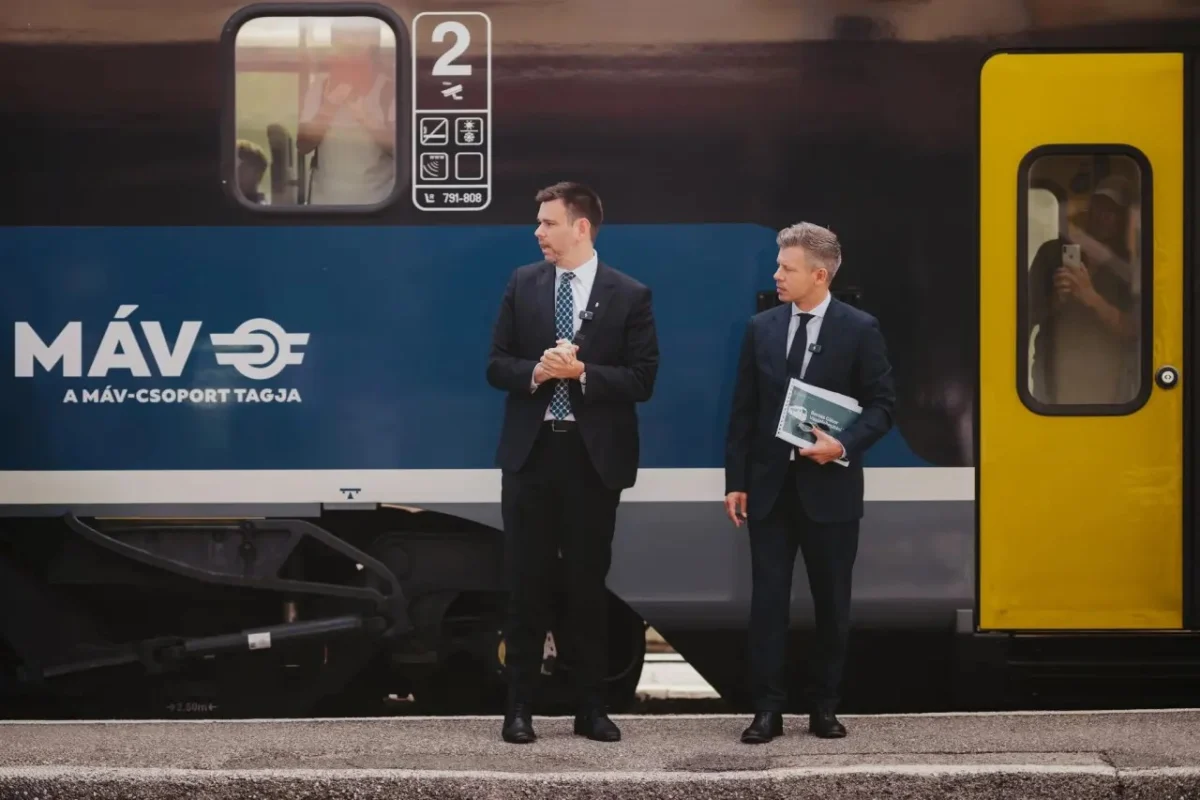
In a landmark shift for Hungarian infrastructure, Prime Minister Péter Magyar and Minister for Transport and Investment Dávid Vitézy have unveiled the "Baross Gábor" railway plan. This ambitious, decade-long investment program, valued at 3,550 billion forints (approximately €9.76 billion), aims to fundamentally restructure the country’s aging rail infrastructure, transition to modern rolling stock, and position Hungary as a central hub in the European high-speed rail network.
The initiative represents the first long-term strategic vision in Hungarian history designed to transcend the political horizon of a single government term. By targeting 2035 as the completion date, the government seeks to reverse decades of systemic neglect and operational decay.
Main Facts: The Scope of the Transformation
The Baross Gábor plan is not merely a maintenance schedule; it is a comprehensive industrial strategy. The government’s primary objectives are to halve the average age of locomotives and railcars, eliminate chronic speed restrictions, and elevate the passenger experience to match Western European standards.
Key pillars of the investment include:
- Rolling Stock Modernization: The procurement of at least 35 state-of-the-art InterCity Electric Multiple Units (EMUs) and 42 modern trainsets for the Budapest HÉV suburban network.
- Infrastructure Upgrades: Significant track improvements to facilitate speeds of 160 km/h and 200 km/h on primary corridors.
- Capacity Expansion: Converting critical sections—such as the Kelenföld–Budaörs–Törökbálint corridor—into four-track lines to separate suburban traffic from long-distance and freight services.
- Regional Connectivity: Reopening mothballed regional routes and implementing a service frequency guarantee of at least five daily connections for all towns with populations exceeding 500 residents.
- The Airport Link: Renewed commitment to a dedicated high-speed rail link connecting downtown Budapest with Liszt Ferenc International Airport.
Chronology of the Development
The development of the Baross Gábor plan follows years of public outcry regarding the unreliability of the state-owned MÁV (Hungarian State Railways) network.
- 2024-2025: Strategic assessment and feasibility studies conducted by the Ministry of Transport and Investment.
- July 2026: Official presentation of the Baross Gábor plan by PM Péter Magyar and Minister Dávid Vitézy at the historic Rákospalota-Újpest station.
- 2027–2029: Procurement phases and initiation of tender processes for the new InterCity and HÉV fleets.
- 2030: Target date for the arrival of the first new InterCity trains and the commencement of major infrastructure works, including the high-speed rail connections toward Vienna and Warsaw.
- 2030–2035: Full-scale implementation of station renovations, regional line reactivations, and track modernization projects.
Supporting Data: A System in Crisis
The urgency of the Baross Gábor plan is underscored by a sobering analysis of the current state of Hungarian rail. The ministry’s data paints a picture of a system that has been pushed to its absolute mechanical limit.

The Aging Fleet
The average age of MÁV rolling stock stands at 43 years, a figure that rises to 50 years for railcars not classified as InterCity standard. This obsolescence results in frequent breakdowns, high maintenance costs, and a lack of modern amenities such as climate control or low-floor accessibility.
Network Constraints
The physical state of the trackage is equally concerning. Currently, 42% of the MÁV network is subject to mandatory speed restrictions due to track degradation. Furthermore, accessibility remains a significant hurdle: of the 50 busiest railway stations in Hungary, only 16 are fully accessible to passengers with reduced mobility. Six are partially accessible, while 28—more than half—remain entirely unadapted for modern mobility standards.
The Procurement Strategy
To address these failures, the government has earmarked 450 billion forints (€1.24 billion) for the purchase of the 35 InterCity EMUs, each capable of seating 400 to 500 passengers. These trains are slated to serve major domestic routes, including:
- Budapest–Miskolc–Nyíregyháza–Debrecen
- Budapest–Győr–Hegyeshalom
- Budapest–Székesfehérvár–Nagykanizsa
- Budapest–Pécs
Simultaneously, the HÉV suburban network will receive a 300-billion-forint (€824 million) injection to replace outdated equipment with 120-meter-long, high-speed (100 km/h) low-floor trains.
Official Responses: Closing the Era of Destruction
During the project’s unveiling, Minister Dávid Vitézy did not mince words regarding the previous administration’s track record. "We are bringing the era of railway destruction to a close and opening a completely new chapter," Vitézy stated. He pointedly criticized the tendency of past governments to halt, postpone, or outright abandon infrastructure projects, which he argued left the public transport system in a state of stagnation.
The government’s rhetoric emphasizes a shift toward long-term planning. By securing funding from a diverse array of sources—including European Union grants, international loans, and strategic private capital—the administration aims to insulate the project from the volatility of national budget cycles. While a substantial portion of the financing relies on future European funds, the government maintains that the project is "bankable" and that the economic return—in the form of reduced freight costs and increased labor mobility—will justify the leverage.

Implications for Hungary’s Future
The implications of the Baross Gábor plan are multi-faceted, touching upon economic, social, and environmental dimensions.
Economic Impact and Freight Efficiency
By addressing bottlenecks on major lines and supporting the construction of industrial sidings, the plan intends to incentivize a modal shift in freight transport. By making rail a more competitive alternative to road haulage, the government hopes to alleviate the heavy lorry traffic that currently burdens Hungary’s motorway network.
Social Connectivity
The commitment to reopen regional lines and ensure that even smaller towns have consistent access to the rail network is a major victory for rural development. By moving toward a 15-minute frequency for suburban services and a 30-minute frequency for major regional hubs like Debrecen, Miskolc, and Szeged, the plan seeks to bridge the gap between the capital and the provinces, fostering a more balanced national economy.
International Integration
Perhaps the most ambitious aspect of the plan is the preparation for high-speed rail links to Vienna and Warsaw. By integrating Hungary into the emerging trans-European high-speed network, the government hopes to enhance the country’s attractiveness for international business and tourism. The design of the new infrastructure specifically allows for trains to pass through Budapest’s hubs rather than terminating there, a critical step in transforming Budapest into a true European transit crossroads.
The Question of Private Capital
The government has explicitly stated that it will seek private capital to modernize the country’s ten busiest stations. While this has raised questions regarding the privatization of public assets, the administration has pledged that strategic land and station infrastructure will remain in the public interest. The goal is to create modern, commercialized hubs that generate revenue for the rail network while ensuring that the primary function of these stations—the movement of people—remains prioritized.
Conclusion
The Baross Gábor plan is, without question, the most significant infrastructure challenge Hungary has undertaken in the post-socialist era. If successful, the 3,550 billion forint investment will do more than just upgrade tracks and trains; it will redefine the relationship between the Hungarian citizen and the state. By prioritizing reliability, speed, and accessibility, the government is making a calculated bet that a robust, modern rail network is the essential foundation for a prosperous, connected, and environmentally conscious 21st-century Hungary. The path to 2035 will be arduous, requiring sustained political will and precise financial execution, but the vision for a revitalized national backbone has finally been set in motion.

