

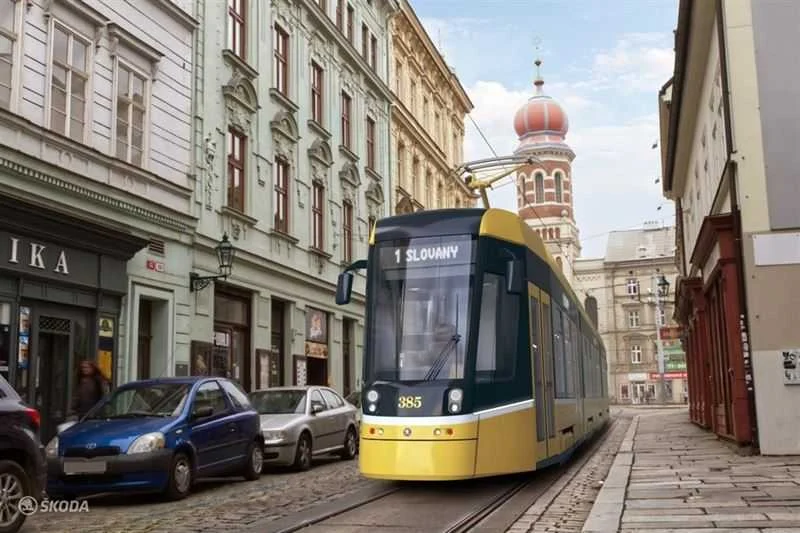
Introduction: A New Era for Urban Mobility
The city of Plzeň has officially entered a new chapter in its public transport history as Škoda Transportation initiated non-passenger test drives for its state-of-the-art ForCity Smart tram. The vehicle, a three-section, high-capacity light rail vehicle (LRV), is currently navigating Line 4 between the University and Košutka stops. This testing phase marks a critical milestone in a broader modernization strategy designed to revolutionize the urban transit experience in the Czech Republic’s fourth-largest city.
As public transport authorities globally grapple with the dual challenges of increasing urbanization and the urgent need for sustainable transit, the introduction of the ForCity Smart platform represents a significant leap forward in engineering, comfort, and operational efficiency. The ongoing testing process, which mandates 20,000 kilometers of operation without passengers followed by an equivalent distance with passengers, underscores the manufacturer’s commitment to safety, reliability, and technical excellence.
Main Facts: Engineering the Future of Transit
The ForCity Smart tram is not merely a vehicle; it is a complex, technologically advanced system designed to meet the rigorous demands of 21st-century urban environments.
Technical Specifications
- Dimensions: A robust 29-meter length designed to maximize space without compromising maneuverability.
- Capacity: Engineered to accommodate 64 seated passengers and 121 standing passengers, based on a standard density of 4 people per square meter.
- Speed: A top speed of 70 km/h, optimized for urban transit schedules.
- Design Philosophy: The tram features 100% low-floor access, ensuring accessibility for passengers with reduced mobility, strollers, and heavy luggage.
- Accessibility: Five double-doors on both sides of the vehicle facilitate rapid boarding and alighting, drastically reducing dwell times at busy stops.
Technical Innovations
The ForCity Smart is built upon a foundation of "swivel bogies," a design choice that significantly reduces axle pressure. This engineering feature is paramount for long-term infrastructure health, as it minimizes wear and tear on the track superstructure. Furthermore, the tram is specifically tuned for the unique topography of Plzeň, characterized by sharp curves and challenging uphill gradients. Its body is constructed to meet the most stringent European safety standards regarding impact resistance, providing enhanced protection for the driver and passengers in the event of a collision.
Chronology: A Roadmap to Modernization
The journey of the ForCity Smart tram from the drawing board to the tracks of Plzeň is the result of years of strategic planning and financial investment.
- 2018: The Initial Agreement. The Plzeň Public Transport Authority (PMDP) awarded Škoda Transportation a landmark contract valued at approximately CZK 1 billion (approx. EUR 39.4 million). This contract outlined the procurement of 22 ForCity Smart LRVs, with provisions for future options.
- 2019: Strengthening the Financial Backbone. To ensure the project’s success, PMDP secured a significant EUR 50 million loan from the European Investment Bank (EIB). This funding was earmarked for a comprehensive fleet renewal, encompassing 34 new trams and 34 trolleybuses.
- 2021: The Testing Phase Commences. Following the assembly and initial factory trials, the prototype transitioned to on-track testing on Line 4 in Plzeň.
- Future Milestones: Once the 40,000 km testing threshold (20k without passengers, 20k with passengers) is met, the fleet will be fully integrated into regular, daily service, replacing the aging rolling stock currently in operation.
Supporting Data: Infrastructure and Investment
The financial structure behind this project is indicative of the European Union’s broader commitment to "green" transport infrastructure. By partnering with the EIB, PMDP has ensured that the acquisition of these vehicles is not just a local procurement project, but part of a regional environmental strategy.
The procurement of 34 trams and 34 trolleybuses is designed to significantly lower the carbon footprint of public transport in Plzeň. Older vehicles, which are inherently less energy-efficient and lack modern regenerative braking systems, are being phased out. The new ForCity Smart fleet is expected to contribute to:
- Lower Energy Consumption: Through advanced propulsion systems.
- Infrastructure Longevity: By utilizing axle-friendly bogie technology.
- Increased Ridership: By providing a modern, climate-controlled, and digitally connected passenger experience.
Official Responses and Perspectives
Industry experts and local officials have praised the collaboration between PMDP and Škoda Transportation. The focus remains heavily on the "Human-Centric Design" of the vehicle.

"The interior of the vehicles corresponds to today’s trends that emphasize functionality and simplicity," stated a spokesperson for Škoda Transportation. "We have focused on ergonomics for the driver, ensuring better visibility and a more comfortable cabin layout, while simultaneously providing a high-tech environment for the passenger, complete with state-of-the-art information systems."
The safety design of the tram’s front end is also a point of pride, as it balances the need for robust collision protection with the necessity of being considerate towards other traffic participants, such as cyclists and pedestrians—a vital consideration for the dense urban core of Plzeň.
Implications: The Broader Impact
The rollout of the ForCity Smart platform extends far beyond the borders of Plzeň.
Scaling to Other Markets
The ForCity Smart model is becoming a global standard for urban rail. Similar variants of the tram are being introduced in Ostrava, as well as in German cities including Mannheim, Ludwigshafen, and Heidelberg. This cross-border adoption demonstrates the versatility of the Škoda platform in handling diverse urban environments across Europe.
The Autonomous Frontier
Perhaps the most forward-looking aspect of the project is the preparation for future autonomy. The ForCity Smart tram is set to be a key participant in autonomous operation testing, supported by the development of a new testing polygon in Borek, within the South Bohemian Region. This suggests that the current fleet is "future-proofed"—designed with the digital architecture necessary to support self-driving or assisted-driving technologies in the coming decade.
Enhanced Passenger Comfort
In an era where public transit must compete with private vehicles, the ForCity Smart prioritizes the passenger experience. With integrated air conditioning, high-fidelity passenger information systems, and an interior designed for maximum comfort, the tram aims to shift public perception of transit from a "necessary chore" to a "preferred commute."
Conclusion: Driving the Future
The testing of the ForCity Smart tram in Plzeň is a testament to the synergy between heritage engineering and modern innovation. As the vehicle covers its 20,000 km without passengers, it is doing more than checking off technical boxes; it is proving that public transport can be efficient, safe, and comfortable.
By integrating these vehicles into the city’s veins, PMDP is not only replacing old machines—they are setting a new standard for how cities should move. As the tram prepares for its debut with passengers, the people of Plzeň can look forward to a transit system that is as resilient as the city itself, paving the way for a cleaner, faster, and more connected future. The successful integration of these trams will likely serve as a blueprint for other medium-sized European cities looking to modernize their infrastructure while remaining fiscally and environmentally responsible.

