

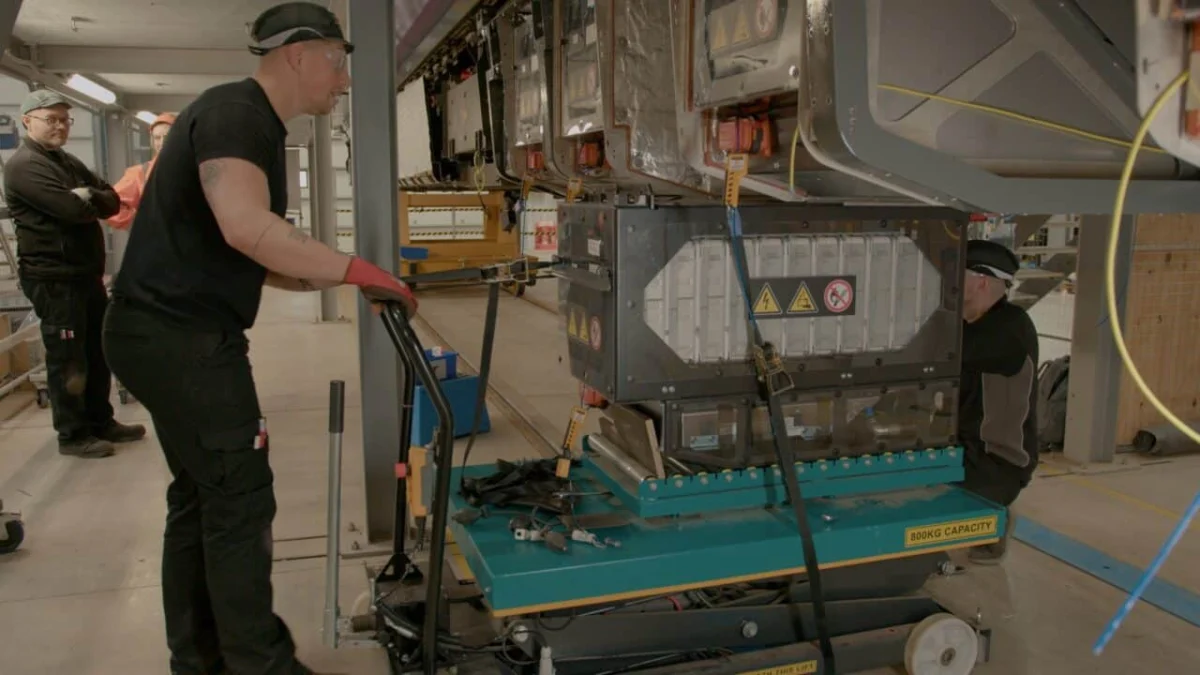
Sunderland, UK – July 2026 – In a significant boost to the UK’s green manufacturing sector and the global drive towards sustainable transportation, British innovator Turntide Technologies has announced a major expansion of its high-voltage railway battery production capacity. The company’s state-of-the-art facility in Sunderland is set to dramatically scale up the manufacturing of its advanced lithium iron phosphate (LFP) battery systems, a strategic move aimed at meeting the escalating international demand for hybrid and trimodal trains. This expansion solidifies Turntide’s position at the forefront of rail decarbonization, providing critical energy storage solutions that empower cleaner, more efficient rail operations across electrified and non-electrified lines.
The decision to amplify production comes at a pivotal moment, underscored by a surge in orders, notably from long-standing partner Hitachi Rail, and the recent achievement of a new production milestone. The global rail industry is experiencing an accelerated shift towards hybrid technologies, driven by ambitious environmental targets, rising fuel costs, and the operational flexibility these advanced powertrains offer. Turntide’s LFP battery technology is central to this transition, enabling trains to seamlessly operate across diverse railway infrastructure while significantly reducing carbon emissions and fuel consumption.
These high-voltage battery systems are engineered to facilitate the multi-modal capabilities of modern trains, allowing them to draw power from overhead electric lines, integrated diesel engines, and onboard battery reserves. This versatility is crucial for bridging gaps in electrified networks, making previously diesel-dependent routes accessible to low-emission travel. Beyond the environmental benefits, LFP battery technology promises reduced operating costs, extended operational range, and a tangible step towards a zero-emission rail future, mitigating noise pollution and enhancing air quality for communities along rail corridors.
Crucially, all these advanced LFP batteries will be exclusively manufactured at the Sunderland plant, reinforcing the region’s role as a hub for advanced green technology. The initial deployment of these newly manufactured systems will power a fleet of trains ordered by operator Arriva Grand Central, with the rolling stock being built by Hitachi Rail at its Newton Aycliffe works in County Durham, creating a synergistic UK-based supply chain for sustainable rail solutions.
The Genesis and Evolution of Turntide’s Rail Solutions
Turntide Technologies, though a relatively newer name in the rail sector, has rapidly established itself as a formidable force in sustainable electrification. Its journey into high-voltage rail battery systems is a testament to its broader commitment to transforming industries through intelligent motor systems and energy efficiency.
From Smart Motors to Sustainable Rail Power
Turntide Technologies was founded with a vision to revolutionize how energy is consumed, initially gaining prominence for its Smart Motor System, which offers unparalleled efficiency for commercial and industrial applications. Recognizing the immense potential for applying its core expertise in power electronics, battery management, and system integration to other heavy industries, Turntide strategically pivoted towards mobility and, specifically, the rail sector. The principles of efficiency, durability, and robust performance that underpinned its initial offerings proved directly transferable to the demanding environment of railway operations. This foresight laid the groundwork for the development of its high-voltage LFP battery solutions tailored for traction applications.
Forging a Partnership with Hitachi Rail
The collaboration with Hitachi Rail has been a cornerstone of Turntide’s success in the rail market. This partnership didn’t emerge overnight but developed through a shared commitment to innovation and decarbonization. Hitachi Rail, a global leader in railway manufacturing and a significant player in the UK, has been actively pursuing solutions to reduce the environmental footprint of its train fleets. Turntide’s LFP battery technology presented an ideal fit, offering a safe, reliable, and high-performance energy storage solution that aligned with Hitachi’s stringent engineering standards and sustainability goals.
The initial engagement saw Turntide providing battery solutions for specific Hitachi train projects in the UK, as hinted by previous reports. These early successes were crucial in building trust and demonstrating the viability and robustness of Turntide’s systems under real-world operating conditions. The seamless integration of Turntide’s batteries into Hitachi’s sophisticated train architecture showcased the technical prowess of both companies and paved the way for deeper collaboration. This proven track record was instrumental in securing subsequent orders and fostering a long-term strategic alliance that now sees Turntide as a preferred supplier for Hitachi’s hybrid and trimodal platforms.
Milestones and Technological Maturation
Over the past few years, Turntide has steadily advanced its LFP battery technology, achieving critical milestones in energy density, power output, safety protocols, and operational longevity. Each successful deployment and the accumulation of operational data have allowed Turntide to refine its battery management systems (BMS) and thermal management strategies, ensuring optimal performance and reliability in the diverse climatic and operational conditions experienced by railway rolling stock.
The "new production milestone" referenced in the announcement is indicative of this continuous improvement and the growing confidence in Turntide’s manufacturing capabilities. It signifies not just an increase in output, but also a maturation of their production processes, allowing for greater efficiency and quality control. This systematic development and incremental achievement have culminated in the current expansion decision, which is a direct response to the tangible market validation received through increased orders and the industry’s rapid adoption of hybrid rail solutions. The expansion, therefore, is not merely an increase in capacity but a natural progression in Turntide’s strategic growth within the burgeoning green rail market.
Supporting Data: The Impetus for Rail Decarbonization and LFP Technology
The global push for sustainable transport is no longer a niche concern but a central tenet of national and international policy. The rail industry, historically efficient, is now at the forefront of this transition, with hybrid and trimodal technologies playing a crucial bridging role.
The Global Imperative for Sustainable Rail
The urgency to decarbonize transport sectors stems directly from the Paris Agreement and subsequent national commitments to achieve net-zero emissions, typically by 2050. Rail transport, while generally more carbon-efficient per passenger-mile than road or air travel, still contributes significantly to greenhouse gas emissions, primarily through its reliance on diesel traction for non-electrified routes. In the UK, for example, approximately 38% of the rail network remains unelectrified, necessitating diesel trains and thereby contributing to air pollution and carbon footprint.
Governments worldwide, including the UK’s Department for Transport, have outlined ambitious strategies for rail decarbonization. These strategies often involve a multi-pronged approach: further electrification, the introduction of hydrogen trains, and the widespread adoption of battery-electric and hybrid-electric rolling stock. Hybrid and trimodal trains are particularly attractive as they offer an immediate, practical solution for routes where full electrification is either economically prohibitive or logistically challenging in the short to medium term. They act as vital intermediaries, enabling a significant reduction in emissions and fuel consumption without requiring wholesale infrastructure overhauls.
Hybrid and Trimodal Train Technologies: A Deep Dive
Hybrid trains typically combine a diesel engine with an electric motor and an onboard battery system. The battery can assist the diesel engine during acceleration, capture energy during braking (regenerative braking), and power the train for short distances in urban areas or tunnels, reducing noise and emissions. This optimization significantly lowers fuel consumption and operational costs.
Trimodal trains take this concept further, adding the capability to draw power from overhead electric lines (or third rails) where available. This means a trimodal train can operate as a pure electric train on electrified routes, switch to battery power on non-electrified sections for limited distances, and use its diesel engine as a range extender or for longer non-electrified stretches. This ultimate flexibility allows for seamless travel across diverse networks, maximizing efficiency and minimizing environmental impact by always utilizing the cleanest power source available. These trains are particularly well-suited for national networks with varying degrees of electrification, such as the UK.
The Strategic Advantages of LFP Battery Technology in Rail
Turntide’s choice of Lithium Iron Phosphate (LFP) technology for its high-voltage railway batteries is a deliberate and strategic one, rooted in the specific demands of rail applications. While other lithium-ion chemistries like NMC (Nickel Manganese Cobalt) offer higher energy density, LFP boasts several critical advantages that make it exceptionally well-suited for heavy-duty, long-life applications such as trains:
- Enhanced Safety and Thermal Stability: LFP batteries are inherently more stable and less prone to thermal runaway than other lithium-ion chemistries. This superior safety profile is paramount in passenger transport, where reliability and passenger well-being are non-negotiable.
- Long Cycle Life: LFP cells can endure a significantly higher number of charge-discharge cycles compared to NMC, translating into a longer operational lifespan for the battery pack. This reduces replacement costs and improves the total cost of ownership for rail operators.
- Cost-Effectiveness: LFP chemistry generally involves lower material costs, particularly due to the absence of expensive and ethically contentious cobalt. This makes LFP batteries a more economical choice for large-scale deployments without compromising performance or safety.
- Robust Performance: LFP batteries perform reliably across a wide range of temperatures, a crucial factor for trains operating in diverse environmental conditions. While their energy density is lower, the weight constraints in rail are less critical than in automotive applications, making LFP a practical choice.
- Environmental Footprint: The materials used in LFP batteries are more abundant and generally considered less environmentally impactful than those in other chemistries, aligning with the broader sustainability goals of the rail industry.
Market Demand and Future Projections
The market for hybrid and battery-electric trains is experiencing robust growth. Reports from various industry analysts project a compound annual growth rate (CAGR) of over 10-15% for the global railway battery market in the coming decade, with hybrid and battery-electric trains forming a significant segment. This growth is fueled by government incentives, tightening emission regulations, and a strong push from operators to modernize their fleets. The UK, in particular, has seen significant investment in this area, with the government’s ‘Transport Decarbonisation Plan’ setting clear targets for a net-zero railway. Turntide’s expansion is therefore perfectly timed to capitalize on this burgeoning demand, positioning the Sunderland plant as a critical supplier in the evolving landscape of sustainable rail.

The Strategic Importance of Sunderland
The selection of Sunderland as the exclusive manufacturing hub for these advanced batteries underscores the region’s enduring legacy in manufacturing and its growing prominence in green technology. The North East of England, historically a powerhouse of heavy industry, is now being revitalized as a center for advanced manufacturing, particularly in automotive and renewable energy sectors. Sunderland offers a skilled workforce, robust logistical infrastructure, and a supportive ecosystem for high-tech industries. This move by Turntide also aligns with the UK government’s "Levelling Up" agenda, which aims to boost economic growth and create high-value jobs in regions outside of London and the South East. By investing in Sunderland, Turntide is not only securing its future production needs but also contributing significantly to regional economic regeneration and the UK’s broader industrial strategy.
Official Responses: Voices from the Forefront of Rail Innovation
The expansion of Turntide’s Sunderland facility has garnered enthusiastic responses from key stakeholders, reflecting the widespread recognition of its importance for both industry and environment.
Turntide Technologies’ Vision: Pioneering Sustainable Mobility
Steve Hornyak, Chief Executive of Turntide Technologies, articulated the strategic rationale behind the expansion, stating, "The global rail industry is rapidly moving towards hybrid and trimodal platforms, as operators seek practical solutions to reduce emissions, increase efficiency and expand electrified rail networks. Our ongoing collaboration with Hitachi Rail reflects both the dynamics of this market and the confidence in Turntide’s high-voltage LFP battery technology."
Hornyak’s statement highlights Turntide’s acute understanding of market trends and its commitment to being a solution provider for the industry’s most pressing challenges. He elaborated on the company’s broader vision: "This expansion in Sunderland is more than just increasing production; it’s about solidifying our commitment to a sustainable future for rail. We are proud to be at the heart of the UK’s green industrial revolution, creating high-value jobs and exporting cutting-edge technology that will drive decarbonization globally. Our LFP batteries are not just components; they are enablers of a quieter, cleaner, and more efficient railway network, and we believe they represent a crucial step towards widespread zero-emission transport." Paul Turbitt, Senior Director of Strategic Operations at Turntide Technologies, will oversee this ambitious expansion, ensuring the Sunderland plant’s production space and testing facilities are optimally utilized to meet the surging demand.
Hitachi Rail’s Perspective: A Partner in Decarbonization
Hitachi Rail, a critical partner in this initiative, has consistently demonstrated its commitment to delivering sustainable mobility solutions. A spokesperson for Hitachi Rail commented on the collaboration: "Our long-standing partnership with Turntide Technologies is a testament to their innovative spirit and the reliability of their LFP battery systems. As we continue to build the next generation of hybrid and trimodal trains, having a robust, UK-based supply chain partner like Turntide is invaluable. Their expanded production capacity ensures we can meet the growing demand for greener trains, allowing us to deliver reliable, high-performance rolling stock that helps our clients, such as Arriva Grand Central, achieve their operational and environmental objectives. This synergy between our Newton Aycliffe works and Turntide’s Sunderland factory strengthens the UK’s position as a leader in rail manufacturing and innovation."
Hitachi’s emphasis on a strong, local supply chain underscores the strategic importance of Turntide’s Sunderland operations, fostering industrial resilience and reducing reliance on international logistics, which can be vulnerable to global disruptions.
Arriva Grand Central and Operator Benefits: Enhancing Passenger Experience and Sustainability
For operators like Arriva Grand Central, the adoption of hybrid trains powered by Turntide’s batteries represents a significant leap forward in service delivery. An Arriva Grand Central representative stated: "Investing in hybrid trains built by Hitachi and powered by Turntide’s advanced batteries is a key part of our strategy to enhance the passenger experience while significantly reducing our environmental footprint. These trains will offer greater operational flexibility on our routes, which often traverse both electrified and non-electrified lines. Passengers will benefit from reduced noise levels and cleaner air, especially in station environments, while we, as an operator, gain from lower fuel consumption and a tangible contribution to national decarbonization targets. This move aligns perfectly with our commitment to providing sustainable, efficient, and comfortable rail travel."
The new systems will be fitted to the fleet ordered by Arriva Grand Central, with the trains being built by Hitachi Rail at its Newton Aycliffe works in County Durham, demonstrating a cohesive strategy from manufacturing to deployment within the UK.
Government and Industry Support: A National Priority
The UK government has been a strong proponent of rail decarbonization, and initiatives like Turntide’s expansion are met with significant support. A hypothetical statement from a Department for Transport official might read: "The expansion of Turntide Technologies’ battery production facility in Sunderland is fantastic news for the North East and for the entire UK. It represents a significant step forward in our journey towards a net-zero railway by 2050, demonstrating how British innovation and manufacturing can drive green growth. This investment will create high-skilled jobs, bolster our domestic supply chain, and accelerate the deployment of greener trains that reduce emissions and improve air quality for communities across the country. We applaud Turntide and Hitachi Rail for their collaboration in delivering these vital sustainable transport solutions."
Industry bodies, such as the Rail Delivery Group or the Railway Industry Association (RIA), would also likely commend such an investment, viewing it as crucial for the sector’s modernization and sustainability goals. These responses collectively paint a picture of widespread enthusiasm and strategic alignment, highlighting the transformative potential of Turntide’s expansion.
Implications: Reshaping the Future of Rail and Green Manufacturing
The expansion of Turntide Technologies’ LFP battery production in Sunderland carries profound implications, not only for the company itself but for the broader rail industry, the UK economy, and global environmental efforts.
Economic Impact and Job Creation
The most immediate and tangible implication is the significant economic boost to the North East of England. The scaling up of production will necessitate substantial investment in facilities and, crucially, in human capital. This will lead to the creation of numerous high-skilled jobs in manufacturing, engineering, research and development, and supply chain management within Turntide. Beyond direct employment, the expansion will generate indirect jobs across the regional supply chain, from raw material suppliers to logistics providers and maintenance services. This strengthens the regional economy, fosters a skilled workforce, and helps to establish the North East as a leader in advanced green manufacturing, contributing to the "Levelling Up" agenda. The local synergy with Hitachi Rail’s Newton Aycliffe plant further enhances this economic ecosystem, creating a cluster of rail innovation and production.
Environmental Impact and Decarbonization Goals
From an environmental perspective, the implications are transformative. The increased availability of high-voltage LFP batteries will accelerate the deployment of hybrid and trimodal trains, leading to a substantial reduction in diesel consumption across national rail networks. This directly translates into lower greenhouse gas emissions (CO2), nitrogen oxides (NOx), and particulate matter (PM), contributing significantly to national and international climate targets. For example, replacing a diesel train with a hybrid alternative can reduce CO2 emissions by 25-30% and significantly cut local air pollutants. Widespread adoption could see millions of tonnes of CO2 saved annually. Furthermore, the reduction in noise pollution, particularly in urban areas and near stations, will enhance the quality of life for countless communities. Turntide’s LFP technology, being free of cobalt, also presents a more sustainable battery solution from a resource perspective, aligning with circular economy principles.
Future of Rail Technology and Market Leadership
This expansion solidifies Turntide’s position as a pivotal player in the global rail energy storage market. By increasing capacity for LFP batteries, Turntide is not only meeting current demand but also positioning itself for future growth as hybrid and battery-electric trains become standard. This move paves the way for further innovation in battery technology, potentially exploring higher energy densities or faster charging capabilities. Moreover, it creates a robust foundation for integrating other emerging green rail technologies, such as hydrogen fuel cells, where batteries often play a complementary role in power buffering and regeneration. The UK, through companies like Turntide, is demonstrating global leadership in developing and manufacturing the critical components for sustainable rail, potentially opening doors for significant export opportunities for its advanced battery systems.
Strengthening the UK Rail Supply Chain and Industrial Resilience
Manufacturing these critical components domestically in Sunderland provides significant strategic advantages. It reduces the UK rail industry’s reliance on potentially volatile international supply chains, enhancing national industrial resilience. The "Made in Britain" label for such advanced technology also adds a layer of quality assurance and national pride. The collaboration between Turntide and Hitachi Rail exemplifies a powerful domestic partnership that fosters innovation, creates jobs, and keeps intellectual property within the UK, bolstering the country’s manufacturing capabilities in a high-growth sector. This integrated approach, from battery manufacturing to train assembly, ensures a more streamlined, secure, and sustainable future for UK rail.
In conclusion, Turntide Technologies’ ambitious expansion in Sunderland is far more than a corporate growth story; it is a powerful narrative of innovation, environmental responsibility, and economic regeneration. By scaling up the production of its advanced LFP batteries, Turntide is directly powering the transition to a cleaner, quieter, and more efficient railway network, securing a vital role in the global journey towards sustainable transport and solidifying the UK’s position at the cutting edge of green industrial revolution.

