


For corporate executives and strategic investors, the modern enterprise’s most accurate real-time dashboard is not found in quarterly earnings reports, but in the aggregation of job postings. Hiring data acts as a sophisticated early-warning system—a tangible record of where capital is being deployed, which technologies are reaching maturity, and where market share battles are being waged. By monitoring the granular shifts in talent acquisition, leaders can anticipate product pivots and capacity expansions months before they manifest in financial statements.
As of April 2026, the global semiconductor sector—the bedrock of the digital economy—is undergoing a period of recalibration. After an aggressive surge in the first quarter, the industry is witnessing a cooling of recruitment momentum. This article provides a deep dive into the current landscape, examining the geographical shifts, thematic priorities, and technical skill requirements that are defining the industry’s trajectory through mid-2026.
The Chronology of Cooling: A Sector in Transition
The semiconductor industry has spent the last year in a state of high-velocity evolution, driven largely by the insatiable demand for generative AI and high-performance computing hardware. However, the data for April 2026 suggests a notable pause in this expansion.
The Q1 Surge and Subsequent Retrenchment
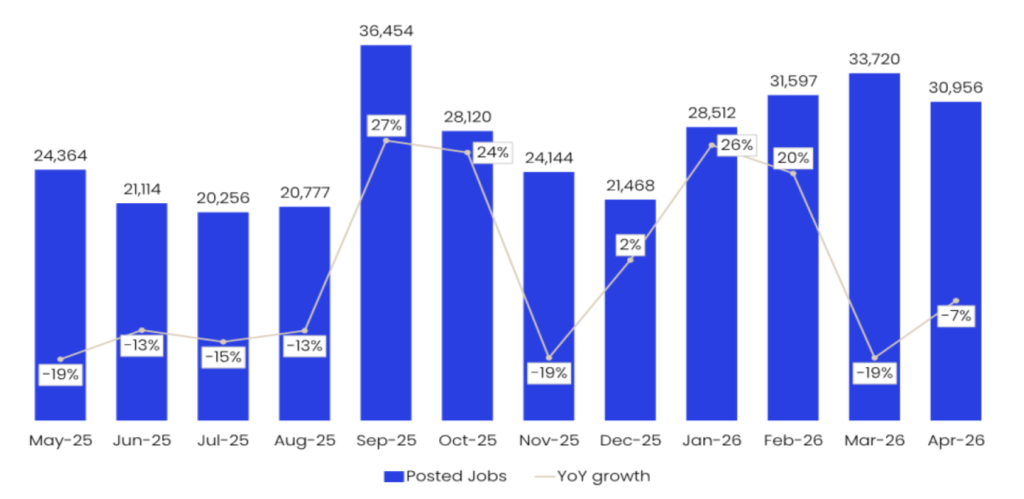
The industry entered 2026 with significant momentum. Following a period of relative stabilization in late 2025, January and February 2026 saw a sharp acceleration in job postings as companies scrambled to scale operations to meet projected demand for AI-adjacent hardware.

However, the momentum proved difficult to sustain. March marked the beginning of a consolidation phase, and April continued this trend, with total global job postings falling by 6.58% month-on-month to 30,956. While this represents a second consecutive monthly decline, it is essential to view these figures in the correct context: despite the pullback, current hiring volumes remain comfortably above the nadir seen in late 2025. Rather than a systemic contraction, the industry appears to be moving from a phase of "hyper-growth hiring" to a more disciplined, strategic recruitment cycle.
Thematic Priorities: Where the Capital Flows
Hiring patterns are the ultimate litmus test for corporate strategy. When a semiconductor firm posts roles, it is not merely filling vacancies; it is signaling a commitment to a specific technological future.
The AI-Cloud-FOW Trifecta
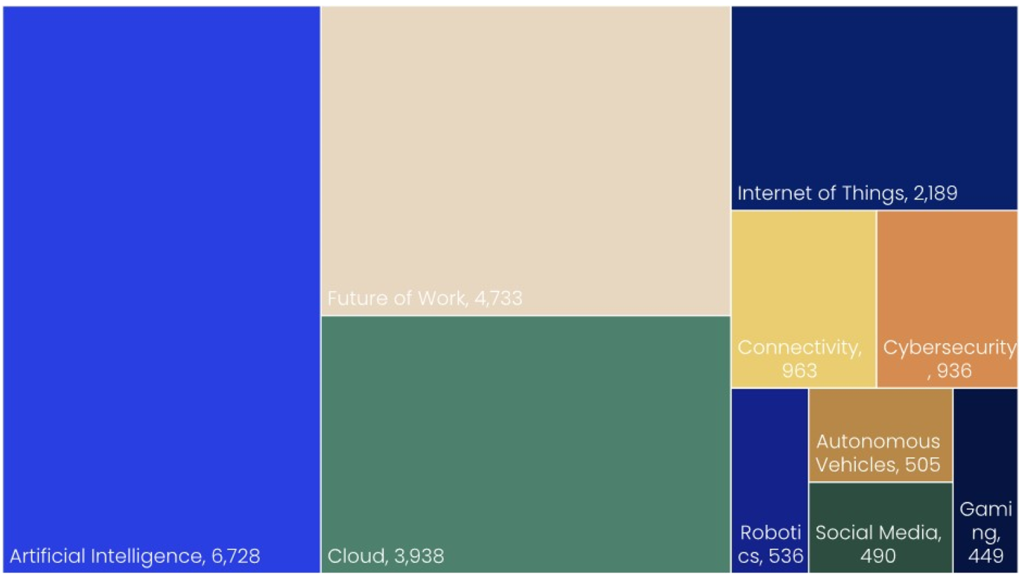
The data for April 2026 reveals a clear hierarchy of investment themes:
- Artificial Intelligence (AI): With 6,728 postings, AI remains the undisputed primary driver of recruitment. The sheer volume of hiring in this space underscores the ongoing arms race in chip architecture designed to power large language models and neural networks.
- Future of Work (FOW): Capturing 4,733 roles, this theme reflects the industry’s internal transformation—digitizing operations, optimizing supply chains through automation, and pivoting to remote-first collaboration infrastructures.
- Cloud Computing: Accounting for 3,938 roles, cloud-linked hiring highlights the symbiotic relationship between semiconductor manufacturing and the hyperscale data centers that house their products.
Beyond these top-tier themes, there is a significant "drop-off." Internet of Things (IoT) and connectivity roles remain relevant but at a substantially lower volume (2,189 and 963, respectively). This suggests that while niche applications like autonomous vehicles and robotics are vital, the immediate, massive capital allocation remains tethered to the infrastructure of the AI and cloud revolution.

Geographic Dispersion: Shifting Manufacturing Hubs
The geography of semiconductor hiring is no longer a static map of established powerhouses; it is a dynamic indicator of where global supply chain diversification is actually taking place.
The Stability of the US and the Rise of Malaysia
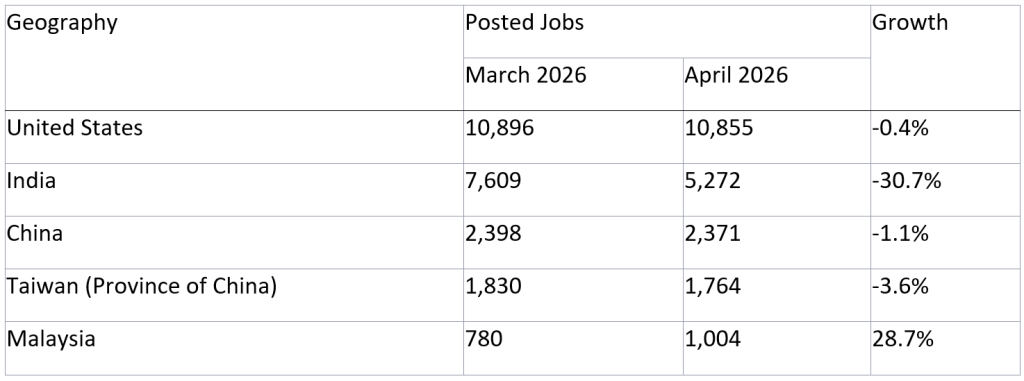
The United States continues to anchor the global sector, maintaining its position as the largest hiring hub. April’s data shows the US market remaining essentially flat (-0.4%), suggesting that while there is no explosive new growth, there is a consistent, high-level commitment to domestic talent.
Conversely, the story elsewhere is one of volatility. India, which had been a significant engine for growth, saw a 30.7% contraction in postings in April. This sharp decline warrants attention—it may indicate a completion of specific project-based hiring cycles or a consolidation of engineering efforts back to core hubs.
The most compelling outlier is Malaysia, which recorded a 28.7% growth in job postings, reaching 1,004. This surge is emblematic of the "China Plus One" strategy, where companies are increasingly diversifying their assembly, testing, and packaging (ATP) operations to Southeast Asian nations to mitigate geopolitical risk and tap into established regional expertise.
Employer Dynamics: Who is Leading the Charge?
The roster of top employers provides a view into which firms are doubling down on their market positions and which are in a period of reassessment.
- IBM: Remained the largest poster in April with 4,248 jobs, though this figure represents a cooling from the February peak of 9,517. The reduction suggests that the initial wave of rapid hiring for specific R&D initiatives may have reached an equilibrium.
- Hitachi: Has maintained a posture of relative stability, keeping hiring at elevated levels (2,300 in April vs. 2,317 in March), indicating a sustained, multi-year capacity build-out.
- The "New" Entrants: The sudden appearance of companies like Infineon in the top-tier list—moving from zero postings in Q1 to 751 in April—highlights the "month-specific" nature of talent acquisition in the semiconductor space. It suggests that specific projects or facility activations are triggering sudden, targeted talent surges.
Technical Skills: The DNA of the Modern Semiconductor Engineer
What does the industry actually need? The skills in highest demand provide a blueprint for the "future-ready" engineer.
The demand is heavily skewed toward Application Platforms and Containers (4,960 postings). This is a critical finding: it confirms that the semiconductor industry is increasingly functioning like a software industry. The focus is not just on the silicon, but on the platforms that allow that silicon to be integrated into enterprise environments.
This is followed by Systems Design and Integration (3,637) and Operating Systems (3,408). These figures suggest that the "value-add" in modern chip manufacturing is moving toward the software-hardware interface. The ability to manage the lifecycle of an application and integrate complex systems is now as valuable as traditional circuit design expertise.
Implications for Leadership: The Strategic Advantage of Hiring Intelligence
For the executive, the lesson of the April 2026 data is clear: hiring signals are a leading indicator, but they require a sophisticated lens to interpret.
1. The One-to-Three Month Window
Market consensus is often backward-looking, relying on quarterly financial reports that are already "old news" by the time they are published. Hiring data offers a window that is typically three months ahead of financial performance. By the time a competitor’s new product launch hits the market, the hiring surge for the engineers who built it occurred months prior. Leaders who track these patterns can anticipate shifts in their competitors’ R&D focus before the first prototype is ever announced.
2. Identifying Overexposure
Monitoring thematic hiring—like the heavy concentration in AI and Cloud—allows a firm to assess its own portfolio balance. If a company is over-indexed on IoT hiring while the rest of the market is pivoting to AI-centric integration platforms, it risks becoming a legacy player. Hiring data acts as a benchmark, highlighting where the industry is collectively placing its bets.
3. Tactical Resource Allocation
The volatility observed in regions like India and the growth in hubs like Malaysia demonstrate that workforce strategy is as much about location as it is about skill. Executives should use this data to evaluate their own geographical footprint. Are you over-reliant on a market that is currently contracting, or are you missing the talent migration to emerging hubs that offer better cost-efficiency or regulatory stability?
Conclusion: From Data to Decision
The cooling of semiconductor hiring in April 2026 should not be viewed as a signal of industry malaise, but rather as a transition to a more calculated, mature phase of growth. The industry is moving from the "gold rush" phase of AI exploration to a "construction" phase, where the focus is on systems integration, platform stability, and global supply chain optimization.
For leaders, the mandate is simple: stop waiting for earnings reports to tell you where the market is going. The talent market is already shouting the answer. By leveraging granular, point-in-time hiring data, companies can transform raw recruitment activity into a strategic weapon, ensuring they are not just reacting to the next market shift, but leading it.
To gain a competitive edge, leaders should look toward integrated analytics platforms that translate complex hiring patterns into actionable intelligence. The future of the semiconductor industry belongs to those who understand that the most valuable asset in the sector is not just the chip, but the human capital building the next generation of computing.

