

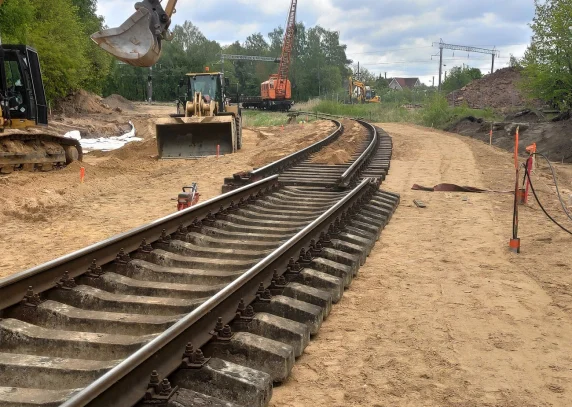
VILNIUS, LITHUANIA — In a monumental step toward integrating the Baltic States with the broader European rail network, Lithuania’s railway infrastructure manager has officially launched a sweeping series of procurement tenders for the flagship Rail Baltica project. Valued at an estimated €475 million, these newly announced tenders represent one of the most significant infrastructure investments in the region’s modern history.
The ambitious program encompasses the construction of the vital rail link connecting Kaunas to Panevėžys, the development of complex regional engineering structures, and the crowning civil engineering achievement of the segment: the longest railway bridge in the entire Baltic region, which will span the picturesque Neris River near Jonava.
As geopolitical imperatives and European connectivity goals converge, Lithuanian authorities are moving with a palpable sense of urgency. Backed heavily by European Union funding, the project seeks to bridge historical gauge divides, boost regional economies, and establish a high-speed, interoperable transport corridor linking Helsinki to Warsaw and beyond.
Main Facts
The latest procurement wave launched by AB Lietuvos Geležinkelių Infrastruktūra (LTG Infra), the infrastructure subsidiary of national railway group Lietuvos Geležinkeliai, centers on the northern stretches of Lithuania’s Rail Baltica corridor.
At the core of this €475 million procurement package are several critical infrastructure milestones:
- The Kaunas–Panevėžys Rail Line: Construction of a brand-new, standard-gauge (1,435 mm) high-speed railway line cutting through central Lithuania.
- The Neris River Bridge: The construction of the longest railway bridge in the Baltic States, spanning the Neris River near Jonava, with an estimated individual cost of €67 million.
- Engineering Structures and Embankments: Extensive civil works including the creation of solid railway embankments, overpasses, underpasses, and animal crossings.
- Connecting Infrastructure: The laying and restructuring of local road connections to ensure seamless integration with existing municipal and national transport networks.
To manage this immense undertaking efficiently, the procurement is structured around a rigorous two-stage international tender process. In the first stage, contractors are vetted against strict qualification, financial, and technical requirements. Only those firms that successfully pass this initial screening are invited to participate in the second stage, where they will submit granular, binding proposals for individual construction objects and components.
Financially, the project is overwhelmingly supported by Brussels. The European Union is slated to fund an impressive 85% of the total project value, with the remaining 15% covered by Lithuania’s national budget.
To optimize construction workflows and mitigate logistical risks, the overall construction of the Kaunas to the Lithuanian-Latvian state border section has been strategically divided into four distinct purchase object groups:
- Railway embankment and civil engineering structure construction.
- The construction of the Neris River bridge near Jonava.
- Upper railway structure installation (including track laying, electrification, and signaling integration).
- The laying and rehabilitation of connecting local roads.
Separate contracts will be awarded for each of these four categories, allowing specialized international engineering consortia and local contractors to collaborate effectively.
Chronology of the Rail Baltica Initiative in Lithuania
The launch of these €475 million tenders does not occur in a vacuum; it is the culmination of years of diplomatic alignment, technical planning, and preliminary civil works.
Genesis and Feasibility (2010–2017)
The concept of Rail Baltica originated from the desire to break the transport isolation of the Baltic States—Estonia, Latvia, and Lithuania—which, as a legacy of the Soviet era, remained connected to the 1,520 mm Russian gauge network rather than the standard European gauge. Following years of political discussions and joint declarations, a comprehensive cost-benefit analysis published in 2017 pegged the total required financing for the entire Kaunas-to-Lithuanian-Latvian border stretch at approximately €977 million, cementing the technical and financial viability of the route.
Project Preparation and Design (2018–2019)
Throughout 2018 and 2019, planning teams finalized spatial planning, environmental impact assessments, and preliminary engineering designs. Lithuania made significant strides in land acquisition along the corridor, navigating complex negotiations with private landowners and municipalities to clear the path for future heavy construction machinery.
The Turning Point: 2020 Procurement Launch
The year 2020 marked the transition from paperwork to physical reality. Facing strict EU funding deadlines tied to the Multiannual Financial Framework (MFF), Lithuanian infrastructure managers accelerated their schedules. By mid-2020, LTG Infra officially initiated the qualification adherence competitions for the embankment, engineering structures, upper track installations, and the iconic Neris River bridge. Concurrently, preparations began for the fourth object group concerning connecting roads.
Execution and the Road to Completion (2020–2023 and Beyond)
With funding applications submitted and partially secured—including a €201 million allocation explicitly earmarked for contracting works, alongside an additional €202 million secured under EU budgetary allocations—the project entered its most intense construction phase. Project leadership recognized that under EU financial rules, these funds carried strict expiration dates, mandating an unwavering commitment to avoiding administrative or legal delays.
Supporting Data and Financial Architecture
Understanding the sheer magnitude of Rail Baltica requires diving deep into the financial numbers, technical specifications, and budgetary frameworks underpinning the initiative.
Capital Investment Breakdown
- Total Estimated Cost (Kaunas to Latvian Border): €977 million (based on the 2017 cost-benefit analysis and updated expert evaluations).
- Current Tender Package Value: €475 million for the newly launched infrastructure works.
- Neris River Bridge Allocation: €67 million out of the €475 million package.
- EU Co-Financing Rate: Up to 85% across eligible project components, representing one of the highest subsidy percentages granted by Brussels for a trans-European transport network (TEN-T) project.
- National Contribution: 15%, funded directly through the Lithuanian state budget.
Funding Streams and Time Pressure
Securing sufficient capital has been a masterclass in international financial engineering. Lithuania has successfully secured substantial European grants through the Connecting Europe Facility (CEF). Most notably:
- An initial application submitted by Lithuania secured €201 million specifically designated for immediate contracting works.
- An additional €202 million in EU funding was successfully secured under the prevailing Multiannual Financial Framework (MFF).
However, this financial abundance comes with strict conditionalities. Under EU budgetary rules, these specific allocations carried a strict utilization deadline of 2023. This regulatory reality transformed Rail Baltica from a standard long-term infrastructure project into an urgent, time-sensitive race against the clock. Any delays in procurement, permitting, or execution risked forfeiting millions in European subsidies, creating intense pressure for project managers to streamline bureaucratic hurdles without compromising engineering standards.

Technical Scope and Parameters
The Rail Baltica line is designed as a greenfield, dual-track, electrically powered railway designed for both passenger and freight transport:
- Track Gauge: 1,435 mm (Standard European gauge).
- Design Speed: Up to 240 km/h for passenger trains, ensuring competitive travel times against air and road transport.
- Freight Capacity: Freight trains up to 740 meters in length, with axle loads up to 25 tonnes, capable of handling heavy industrial logistics.
- Interoperability: Fully compliant with the European Rail Traffic Management System (ERTMS), allowing seamless cross-border operations without locomotive or crew changes at national borders.
Official Responses and Stakeholder Perspectives
The launch of the €475 million tenders elicited strong reactions from key government officials, rail executives, and international stakeholders who view Rail Baltica not merely as a transport project, but as a geopolitical necessity and economic game-changer.
Karolis Sankovski: A Call for Urgency and Precision
Karolis Sankovski, the then-director-general of AB Lietuvos Geležinkelių Infrastruktūra, emphasized the dual priorities of administrative transparency and relentless execution speed. Discussing the structure of the tenders, Sankovski explained the rationale behind the two-stage procurement model:
"In the first [stage], construction companies matching qualification requirements will be selected, and in the second stage, the selected companies will submit the specific proposals for individual construction objects and components."
Addressing the financial and temporal pressures imposed by Brussels, Sankovski did not mince words regarding the necessity of immediate action:
"Additional EUR 202 million EU funding was secured by Lithuania and under the actual MFF, the European financing must be used until 2023. Thus, there can be no delay, and in order to complete the project in time, we must begin executing the work as soon as possible."
Broader Governmental and European Reactions
Lithuanian Ministry of Transport and Communications officials echoed Sankovski’s sentiments, framing Rail Baltica as the "Project of the Century" for the Baltic States. Government leaders have consistently stressed that the railway is vital for ending the transport isolation of Lithuania, Latvia, and Estonia from Western Europe, while simultaneously serving as a crucial military mobility corridor.
At the European level, the European Commission and the Innovation and Networks Executive Agency (INEA)—now known as the European Climate, Infrastructure and Environment Executive Agency (CINEA)—haunted Lithuania’s proactive procurement approach. EU coordinators have frequently cited Rail Baltica as a model for how TEN-T core network corridors should be implemented: through coordinated regional cooperation, transparent competitive bidding, and strict adherence to technical interoperability standards.
Implications for Lithuania, the Baltic Region, and Europe
The rollout of these multi-million-euro tenders carries profound, far-reaching implications across economic, geopolitical, environmental, and logistical dimensions.
Economic and Industrial Transformation
For Lithuania’s construction, engineering, and manufacturing sectors, the €475 million tender represents a historic commercial windfall. By splitting the procurement into four distinct groups, LTG Infra ensured that local small- and medium-sized enterprises (SMEs), alongside specialized domestic contractors, could participate alongside major international engineering giants. This approach fosters knowledge transfer, stimulates job creation, and boosts GDP during periods of macroeconomic uncertainty.
Once operational, the economic impact shifts toward logistics and trade. Businesses in Lithuania and the broader Baltic region will gain direct, uninterrupted access to the Central and Western European market. Shipping goods to Poland, Germany, and beyond will no longer require complex freight transshipment at the Polish-Lithuanian border (where the historic gauge break currently necessitates moving cargo from 1,520 mm wagons to 1,435 mm wagons). This reduction in transit times and logistical friction will drastically lower shipping costs, making Baltic ports and manufacturing hubs significantly more competitive globally.
Geopolitical Resilience and Military Mobility
In the wake of shifting European security dynamics, infrastructure is increasingly viewed through a strategic security lens. Rail Baltica is not just a commercial corridor; it is a vital military mobility asset. NATO and the European Union have repeatedly emphasized the need to move heavy military equipment, troops, and supplies rapidly across the European continent.
The current lack of standard-gauge rail connections has historically hindered military logistics between Western Europe and the Baltic states. By establishing a high-speed, standard-gauge rail line directly connecting Central Europe to the borders of the Baltic states, Rail Baltica dramatically enhances regional defense capabilities. The engineering structures being built—including heavy-duty bridges, reinforced embankments, and dual-use logistics terminals—are explicitly designed to accommodate heavy military hardware, thereby reinforcing NATO’s eastern flank.
Environmental Sustainability
Transport is one of the leading contributors to carbon emissions across Europe. By shifting significant volumes of freight from carbon-heavy road transport (trucks) to electrified, high-speed rail, Rail Baltica aligns perfectly with the goals of the European Green Deal. Passenger travel will likewise be revolutionized: travelers will be able to journey from Tallinn through Riga, Kaunas, and Vilnius down to Warsaw and Berlin in a fraction of the time currently required by bus or car, and with a carbon footprint that is exponentially smaller than aviation. The construction phase itself is subject to rigorous environmental monitoring, ensuring that sensitive ecosystems, such as the Neris River basin, are preserved through state-of-the-art engineering practices.
Conclusion
The launch of the €475 million Rail Baltica tenders by Lithuania marks a defining milestone in the realization of a unified European transport space. By methodically structuring procurement into manageable, specialized packages—ranging from complex embankment works to the historic Neris River bridge—LTG Infra has laid a robust foundation for timely execution.
Driven by the dual imperatives of strict EU funding deadlines and a grand vision of regional integration, Lithuania is forging ahead. When completed, Rail Baltica will transcend its identity as a mere engineering marvel; it will stand as a enduring symbol of connectivity, economic vitality, and collective security at the heart of the New Europe.

